
I get why people hate AI. I also get why people love it. (Nuance P.T. 2)
As of October 2026, a lot of people hate AI.
I think hate towards AI can be broadly categorised into the following reasons:
- AI is hurting creatives.
- AI is hurting critical thinking.
- AI is producing slop.
- AI is damaging to the environment.
- AI is controlled by tech overlords.
- AI is trained on stolen intellectual property.
- AI is going to take my job.
- AI is unsafe (scams, mass surveillance, bioweapons etc.)
- AI is girlfriend/boyfriend.
- AI is a bubble.
In light of the points I made in part one, let's bring nuance into the scene. I am neither an AI worshipper nor a luddite, I am just here to paint the bigger picture. I get incredibly frustrated when people are simply tribal on such a revolutionary piece of technology. It's a profound change in human civilisation and deserves deep thought on it. This time, TikTok videos probably won't cut it.
The first nuance general anti-AI sentiment lacks is of course that AI is a huge category of technology. Saying you are just anti-AI is a bit like saying you are anti-maths, or anti-psychology. AI is a legitimate field of computer science that has had decades of developments, setbacks and breakthroughs. It went through multiple "AI winters" in the 1970s and late 1980s as research progress stalled and the best computer scientists gave up in its development. Broadly speaking, it can range from machine learning models, to chess engines like Stockfish, to large language models, which are the tech behind ChatGPT. There are wildly different AI researchers and teams applying different techniques to wildly different problems. AI stands for artificial intelligence, which just means trying to create smart, autonomous systems that are not organic, like how aero engineers create things that fly that are not organic. Lots of things fly, lots of things can be smart.
Let's address each of the points and argue both for and against the wider impacts of AI.
1. "AI is hurting creatives."
I like creatives. Many of my friends are musicians. Lots of others such as filmmakers, photographers, artists, and so on contribute a lot of creativity, expression and value to our world.
AI can hurt creatives. I'm not going to sugar coat it. Creatives live and die by the attention and money of the masses. If you can capture people's attention and interest as a creative, with some willingness to pay, you'll survive and do decently well. However, AI empowers non-creatives to pump out mass slop and divert attention from real artists. This slop contributes no artistic value and turns your brain into a homogenous soup.
The counterargument here is that slop is not new. We've had human slop for decades and decades. AI, as of 2026, is just a tool directed by humans. Humans have always used whatever is at their disposal to scam, distract or just generally hustle others. Before AI we had bot farms, before bot farms we had gossip editorials and so on. The tools make it more mass produced and powerful, but blaming the tool is always taking attention away from the people wielding it.
Another perspective is that artistic value is often in the eyes of the beholder. From what I can see on the internet, at least some people can distinguish slop from real art. I remember once riding a bus in Bangkok and seeing the person next to me watch a TikTok of a banana getting cut up and put into a toilet, or something to that effect. She watched the whole thing from start to finish, full attention. If AI creates art that evokes emotions or entertains, does it matter that it was created without intention? One could certainly argue both ways. And this certainly isn't exclusively an AI problem. Again, bigger picture. It's funny because a subset of "serious musicians" I follow on YouTube or talk to in real life would always criticise pop music for being formulaic and generic, and yet by definition, most people I know love pop music and don't care about the musical craft and "artistic value". They want a good time and something catchy to dance to and it delivers just that.
What about artists that use AI as a tool? For instance, if I can compose a piece of music but not be able to afford an orchestra to record it, is it ok to use AI to mock it up as a demo? If it's really good, can I publish it as a recording? What if I drew a painting and used AI to help me market it? It is just a tool. It can be used... for anything!
2. "AI is hurting critical thinking."
Sometimes I feel more stupid in this AI age than I used to be. I've forgotten how to run code in my head, all my maths skills are a bit discounted and my willingness to debug things on my own is now non-existent. In many senses, I'm a bit dumber now than I used to be.
Let's travel back 200 years, you are a tax agent working for your government and a top accountant. If I asked you to multiply 3242345 with 452353, how would you do it quickly enough to keep your job? We are taught multiplication in our first years at school and yet, most people would have no idea and their understanding of this problem amounts to something like "the calculator does it pretty quick". It turns out there were huge books of lookup tables, to translate large numbers into representations that you can just add, and then you use the book to translate back to a number. So many skills are lost to time and innovation. I have no idea how to start a fire.
We all have finite time as humans. The problems we are able to understand deeply and be able to solve are finite. Whilst AI does take away the need for us to do some intellectual tasks, it creates more problems at a higher abstraction level for us to scratch our heads at. How do you coordinate and check AI agents, for instance?
Again, AI is just a tool. Large language models can be used to cheat your way through an exam, or you can use it to quiz you during revision. There's no reason why you can't leverage the tool against yourself and increase your intellectual load.
Another interesting point I often think about is how the people who lack critical thinking have always struggled with misinformation. Before AI there was the internet and Alex Jones, before Alex there were news tabloids, before that you had no literacy rate and had to rely on village gossip. People being lied to and believing in it is not at all new. In fact, I would argue AI, as shipped by Claude or ChatGPT, is far better than any mass information distribution tool we've had so far in that there's one party that's actually accountable and watched for the content it outputs and that it tends to output bland, non-political, consensus facts that steer the user away from radicalism, scams and sources with ulterior motives.
My mum, for instance, loves watching shorts on WeChat and frequently believes random superstitious nonsense or, what I often see on there, old people dressed up as experts talking convincing nonsense. After I encouraged her to use ChatGPT, she's gotten much better at fact checking and relying on it as a source of truth. Critical thinking is a bit like swimming, everyone can learn it, but not everyone does, and we are all drowning in bullshit.
3. "AI is producing slop."
I think in 2026, fewer and fewer people are arguing that AI just produces garbage. I remember back in 2024, so many tech influencers like ThePrimeagen were absolutely confident that AI progress will hit a wall and it'll never reach human levels of coding. Anthropic (the company behind Claude) CEO Dario Amodei was ridiculed for saying, "I think we will be there in three to six months, where AI is writing 90% of the code. And then, in 12 months, we may be in a world where AI is writing essentially all of the code." His timeline was a bit optimistic, but in Stack Overflow's 2026 survey, 66% of developers who use AI use coding agents, and 73% of coding assistant users use them daily. All my friends working in big tech and trading firms are all coding with AI. Ironically smaller firms are more resistant but it's only a matter of time.
Does AI produce slop? As someone who codes with Claude day in and day out, absolutely it does. Without close oversight it produces garbage UI and introduces weird bugs into the code base. But it's getting rarer and rarer and the things it is actually capable of seem to be more and more. Creating and editing videos, ASCII art are both things the newest model Claude Opus 5.5 excels at and it's only going to get better from here.
Here there is an interesting gap between the quality of AI most people are familiar with vs the true frontier. AI is expensive. What most people see using free ChatGPT, and the random slop images and videos that some bot farm is mass generating for clicks, is pretty abysmal compared to the biggest and best models AI labs have internally. The intelligence and quality gap, and the price gap, is huge. Earlier this month, OpenAI released over 700 maths papers written by an unreleased internal model, including a proof of what's called the quasi-Riemann hypothesis. Three were withdrawn for errors within a day, and this week it announced more, in harmonic analysis, complexity theory and quantum field theory. It'll still occasionally blip like AI tends to but its utility, intelligence and capability are a bit scary. This also explains some of the huge perception gaps between people in the industry hyping it up and people who don't pay for AI not understanding what the big deal is. See this great write-up by Andrej Karpathy, a super smart, grounded and legit AI scientist.
AI in its current LLM or diffusion architecture will always produce some slop. It only produces what we teach it and has no taste or "consciousness" of its own. It has a lot of emergent properties that look like intelligence and consciousness but it doesn't have some of the properties we have like learning continuously and efficiently. It also doesn't have free will and judgement although these properties are perhaps hard to define even for humans. Without its own autonomy and acting as its own entity, it'll by definition always produce some "slop". This is especially true for the large AI companies serving the same very average/bland models to millions of users, and the model sacrifices quality to lower risk and provocation.
4. "AI is damaging to the environment."
AI datacentres are resource intensive. They use a lot of water for cooling and generating all the gigawatts of power consumes both a lot of water and a lot of electricity. They also take up a lot of land and manufacturing electronics is a rather dirty process. Make no mistake, they are pretty expensive environmentally.
The nuance here is that they do generate value. Many many industries are just as resource intensive. The part 1 to this topic explores how the oil industry keeps our modern society afloat. Farming is even more water intensive (agriculture uses about 70% of the world's freshwater) and bad practices can lead to top soil degradation. Cities introduce light pollution and airplanes dump greenhouse gases straight into the sky.
When it comes to resource consumption, everything is a trade off. Something's got to give. For scale, data centres used about 1.5% of the world's electricity in 2024, and the IEA expects that to roughly double by 2030. Air conditioners and fans use about 10%. The datacentre's environmental footprint is amortised across all its users, meaning we all contribute a little to the environmental damage when we use it. It's more about whether we generate more value compared to the cost.
Suppose we use AI datacentres to make medical breakthroughs and invent new treatment strategies for deadly conditions like cancer. Would that justify the environmental cost? Suppose we use it to make breakthroughs in solving climate change itself, that would be useful. The world runs on energy. We need energy to stay fed and comfortable. The only way to generate energy without greenhouse emissions is for us to invent better energy technology, and one of the fastest foreseeable ways to do so is to invest in AI to research promising ideas for us.
Reality is probably somewhere in between the 100% efficient, all resources are spent on useful research and the 0% efficient, more cat slop videos to entertain mums. We'll never be perfectly efficient as a species and society but that's ok. We want to advocate to get closer to the 100% side and make AI worth all the money and trouble we are sinking into it.
5. "AI is controlled by tech overlords."
I don't like the techbros leading the AI race. This is probably one of the points I most strongly agree with personally. I am highly sceptical of concentrated power and a few people controlling a powerful new emerging technology.
People are inherently selfish. Billionaires and world leaders are no different. Dario, Sam, Elon and Mark likely aren't spending billions of dollars altruistically. They want to make more money for themselves, their shareholders and gain more control of tech in the future. Heck, it's not just tech bros. Trump just renamed AI to Super Intelligence. Everyone wants a piece of the cake.
To play the devil's advocate, these people in power do provide value to us in coordinating and driving progress. It's extremely stressful being a CEO or world leader and sometimes, your interests are aligned with the general welfare of the people. When the early OpenAI team made the big bet to scale up the models and took a huge risk with no certain reward to create LLMs, that was a bold move and directly led to a leap in humanity's understanding of intelligence in general. They allocate billions in resources to build data centres and power products and services we all consume and use. For instance, in the old non-LLM data centre world, Amazon Web Services operated (and still operates) huge data centres all over the globe powering close to 30% of the world's cloud computing. They make a lot of money, but they do provide value.
I guess in the end this is more about checks and balances, and aligning the incentives such that we all benefit from this technology.
6. "AI is trained on stolen intellectual property."
This is a tricky one. IP laws exist for a lot of good reasons. The biggest one is ensuring the creator is properly acknowledged and compensated. It also ensures the people who innovate can continue to do so safely.
The first generations of LLMs operated full SF start up style and somewhat dodgily procured a lot of data from the internet through piracy and general web scraping. This was run at a massive scale and discreetly. This is clearly wrong and much copyrighted content was not compensated for at all. I believe there have been several lawsuits around this already.
The other more interesting nuanced part of this problem is what if the training company just buys one copy of every training data. As humans we find it acceptable to pay once for a piece of media and consume it for learning or enjoyment. In general we are always free to remix or create new content inspired by old ones.
What about LLMs? They do "remix" the knowledge they consume by training them into "weights" in the model itself. If you download an AI model, you won't find any Moby Dick text in there. However, they are so good at memorising, they can just recite it to you almost perfectly from memory. Currently the frontier labs ban this and train it not to, but it can. And even if it doesn't, is serving a model that has gained the knowledge of a book not to one human, but millions of humans fair use? Should machines be allowed to gain and distribute knowledge in this way? I don't know the answer.
7. "AI is going to take my job."
I find this sentiment particularly funny. Not because I'm a sadist that enjoys seeing people lose their jobs and suffer, but because I remember very distinctly that before AI, everyone was complaining about their 9-5 and having to work at all!
People just love complaining, it's in our nature. It is satisfying to shake your fist at the clouds.
Obviously people losing income and not being able to participate in society is terrible, no doubt about it. The real underlying argument here for the anti-AI folks is not that they love work, but that they'll lose their bargaining power in society. For the longest time in history, you can use your labour, skills or smartness to trade with others and earn resources. Once AI and robots take over and most people can't generate any financial value to society, they'll lose power and be obsolete. This is a genuine concern.
The optimist in me would like to believe that we can create a social system designed so people don't have to work, and that resources are always provisioned for everyone to live happy, satisfying lives. It'll be hard to get there, and greed will certainly keep getting in the way, but it's the only happy ending to this whole situation. A future like that doesn't sound too bad to me. In the best case, we'd all have plenty of free time to explore our hobbies and interests and not be locked into a job we hate just to survive.
The bad ending is that all the money goes to a few people holding lots of power and we live in a dystopia polarised between the poor and the rich. See point 5. I'm really hoping we don't get there.
Of course, none of these reasons matter to the young people entering the workforce now where companies are spending big on AI and less on new talent. I can empathise with that. And honestly the only answer to being caught in this situation is that it sucks.
8. "AI is unsafe (scams, mass surveillance, bioweapons etc.)"
With great power comes great responsibility. Honestly, we have no idea what's going to happen in the next few years of AI development. Will they turn on humanity? Gain consciousness? Replace all governments? Nuke us all? We just don't know.
What we do know is that as tools get more and more powerful, they need more and more regulation and control.
What we also know is that power needs to be distributed for society to be functional and stable. Checks and balances are important.
AI can be used for cyber defence or cyber offence. It can be used to aid humanity or destroy it.
I don't really have any insights or unique points to share here, I think we all just have to play it by ear and see how it goes. This train is not stopping and we'll just have to deal with whatever comes up.
9. "AI is girlfriend/boyfriend."
Despite the joke title, this explores the wider point of AI prevalence and its impact on human lives both socially and emotionally. In the movie Blade Runner 2049, Ryan Gosling has a holographic girlfriend. When he gives her a gift and they kiss passionately in the rain, his girlfriend freezes due to the urgent incoming voice message (watch the clip).
If I could buy a hologram of Ana de Armas who loves me unconditionally I would be very tempted too. But the hollowness and lack of real human to human connection is highlighted here. If AI is everywhere and can satisfy all our deepest desires without needing human connection, what have we lost?
To some degree we already see this with para-social relationships on the internet and people falling in love with OnlyFans creators. To some extent we are self-regulating and can tell the difference between real and fake relationships and actually desire people who can push back every so often, but there are a lot of wider implications here.
I, for example, have always wanted a home butler robot that can do all my chores for me. Shop, cook, clean. Yet often I find it's those very activities that tap into the primal part of my brain that makes me feel grounded and at peace. It's probably why an Australian man from Queensland can get almost a hundred million views building mud huts in the bushes.
10. "AI is a bubble."
I am a software engineer by trade. Google says 75% of its new code is now written by AI and then reviewed by engineers.
From a pure experiential perspective, AI is not a bubble. I work at a start-up and at work, we've fully adopted AI to write code and drafts. It's also used to analyse data, generate graphics and help with admin chores. Adoption is real and real money is being spent on Claude and ChatGPT.
However, there is also a strong argument to be made for there being a financial bubble. The spike in a lot of AI related stock tickers is speculative and a lot of the insane amounts of investments and deals done in the AI world look somewhat circular and also speculative. Hank Green has a great video on this.
Justice for Hank Green
Also, in finding Hank's video, I just found the perfect example of why I wrote this. It turns out if you google Hank Green AI, all that comes up is people berating him for using ChatGPT to research one of his scripts. How apt then is this article about nuance, ha. It turns out, people love being vocal bullies, especially on the internet. It is truly timeless to use moral righteousness as an umbrella to act like jerks to particular individuals or groups of people.
I would personally argue that there's nothing inherently wrong with using AI to create content or help create content. Good content is good, bad content is bad. To create a controversy and attack a well known character who has shared nothing but consideration, good-will and nuance even if you disagree with what they do or what they say is a pretty low blow.
Context matters
Different readers will have different experiences and different trade-offs on why they are pro or anti AI use in their context. I for instance fully agree that AI should NOT be used to write music autonomously. The entire point of art is to craft human messages and meaning for other humans. Sure, you can use it to learn about music theory, or bounce ideas off, but using it to mass generate and spam the world with mediocre average garbage is just a waste of compute and everyone's time in a desperate ploy for money.
I was also reading about Codeberg's stance on AI. This is a great example of great reasoning and a well thought out set of rules and policies on the issues created by LLM generated code/projects. It's not perfect, everyone may not agree, but it has nuance and vision to back it up.
It is probably appropriate at this point to point out that the website you are reading this on right now is completely coded by AI, and moreover, vibe coded by AI. I did not even read a single line of source code. Why? Because I know static pages are harmless. I do use AI to help with some research and editing and critique but have opted to write the English version of all of these blogs manually. If I ever translate these to other languages, I'll probably get AI to do it since it's cheap and quick.
Empathy
In heated debates it helps to have empathy.
I can empathise with the anti-AI crowd for sure. One of the more emotional reasons for disliking AI is that it sucks to "lose" to a machine. For as long and as far as we could know, humans are uniquely intelligent in the universe. It's kind of our defining trait as a species and it made us special. People like being special. I like feeling special. All of a sudden there's a threat of intelligence being "artificial" and can threaten our uniqueness and value as a species. It is just kind of plain upsetting news.
I can also empathise with the pro-AI crowd. It closes the gap between the cans and can'ts. I was a very good computer science student and yet I could not maintain a complex CI/CD pipeline all by myself. Now I can. I can also learn about history and jump around and ask questions, no matter how complex or stupid, and get an instant answer without judgement. Now I can just do more. It is pretty fun.
Does this debate even matter?
Yeah, it does. The debates and lines we draw nowadays set precedents for how, when and why AI should be used.
There will never be a blanket ban of AI. Society walks towards incentives. It is too powerful and valuable to governments and big corporations. It also generates value, which means that the majority of people simply don't care about the above points and will use it to make money.
The best outcome will, in my opinion, be AI being democratised and accessible to everyone as a tool. Its use will be regulated for safety, and blatant misuse will be penalised or shunned by the general populace.
Some things are clearly bad for everyone and some things are clearly good for everyone, but most things are in the middle in a grey zone with countless trade offs and small groups of winners and losers.
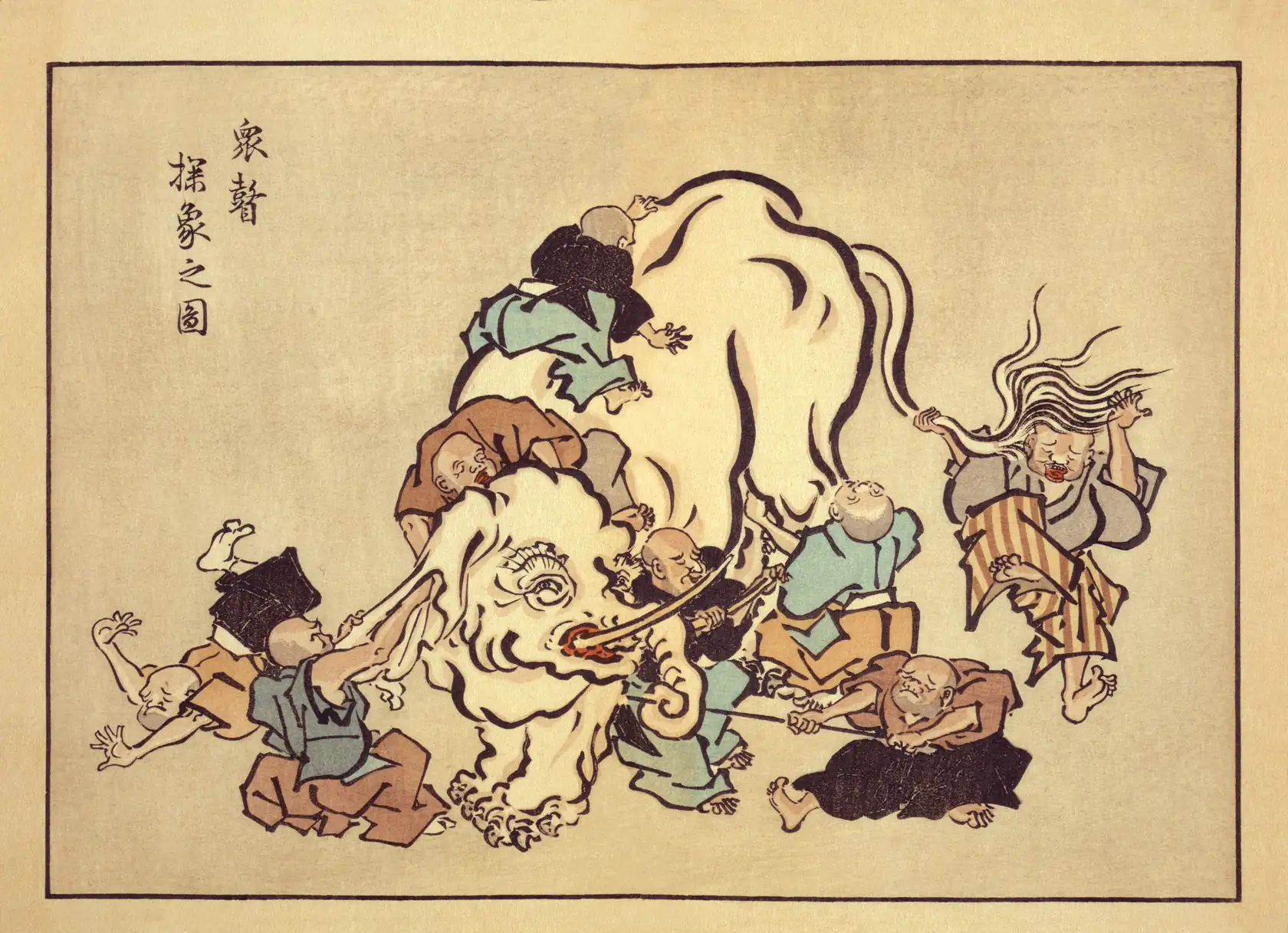
Take a step back, think of the bigger picture. You'll always gain something by seeing the whole elephant.